
Mumbai Faces Water Crisis as Indefinite Tanker Strike Disrupts Supply
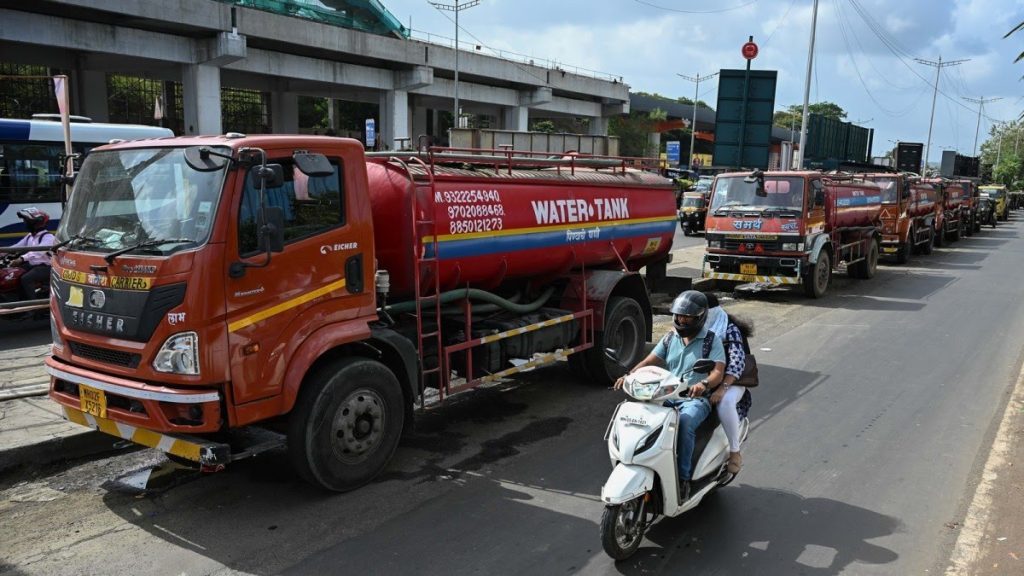
Mumbai, 9th June 2026: Mumbai’s ongoing water crisis deepened on Monday as an indefinite strike by water tanker operators disrupted supply across the city, forcing housing societies to impose water cuts, offices to send employees home early, and railway authorities to scramble for alternative arrangements.
The strike, called by the Mumbai Water Tankers Association (MWTA), comes at a time when the city is already grappling with a 10 per cent reduction in water supply imposed by the Brihanmumbai Municipal Corporation (BMC) due to declining water levels in reservoirs.
Housing Societies Impose Water Cuts
Several residential complexes dependent on tanker water reported severe disruptions. At Kanakia Rainforest in Marol, a residential complex comprising 600 flats across ten buildings, residents were forced to endure a nine-hour daily water cut.
“We were already procuring nearly 20 water tankers daily because of the BMC water cut. With the strike now underway, the situation has become much worse,” said a resident. The society has implemented water restrictions during both daytime and nighttime hours to conserve available supplies.
In Malad, a 204-flat residential tower near Infinity Mall also expressed concerns over dwindling reserves. Residents stated that the building receives only about 60 per cent of its water requirement from the municipal supply and relies heavily on tankers for the remaining demand.
“If the strike continues beyond a couple of days, we may face an acute shortage,” a resident said.
Commercial Establishments Shift to Work From Home
The impact was equally visible in Mumbai’s commercial hubs. At Marol Plaza in Andheri East, several offices were compelled to send employees home and adopt work-from-home arrangements.
According to management officials, the commercial complex depends on 10 to 15 water tankers every day to meet the needs of more than 450 employees. The disruption has affected not only office operations but also support staff, including sanitation workers and peons, whose earnings may be impacted by reduced workplace activity.
Railways Report Water Shortage
The strike has also affected essential public services. Western Railway reported a nearly 20 per cent shortfall in water availability at major stations, including Mumbai Central, Bandra Terminus, and Dadar.
To manage the shortage, railway authorities have shifted train watering operations to stations in Surat and Valsad. Coach washing activities have also been temporarily suspended as part of conservation measures.
Infrastructure Projects Under Pressure
Major infrastructure projects undertaken by the BMC, including the Coastal Road (North) project and the Goregaon-Mulund Link Road, have begun feeling the impact of the disruption. Water tankers play a crucial role in construction activities such as concrete pouring and excavation work.
Civic officials indicated that while the immediate impact remains manageable, prolonged disruption could significantly affect project timelines, particularly as tunnel excavation work is scheduled to begin later this month.
Why Are Tanker Operators on Strike?
The strike stems from notices issued by the Tehsildar’s office to well owners and borewell operators supplying water to tankers. The notices direct operators to cease supply and obtain fresh licences from the Central Ground Water Authority (CGWA).
Under CGWA regulations, licences are granted only for wells located on land parcels measuring at least 200 square metres, and only one tanker is permitted to draw water from a single well. According to the MWTA, more than 300 tanker operators have already received notices.
MWTA spokesperson Ankur Sharma said the association had written to the administration on May 28 seeking intervention but had received no response.
The association has now appealed to Maharashtra Chief Minister Devendra Fadnavis, Mayor Ritu Tawde, and Municipal Commissioner Ashwini Bhide for an urgent meeting. Tanker operators are demanding assurances that no punitive action will be taken against them.
Government Yet to Intervene
BMC officials stated that the issue falls under the jurisdiction of both the state government and the Union government, limiting the civic body’s ability to resolve the matter independently.
A senior civic official noted that if the state government authorises the BMC to invoke provisions under disaster management laws, the corporation could temporarily take control of tanker operations to ensure uninterrupted water supply.
With reservoir levels continuing to decline and tanker services suspended indefinitely, concerns are mounting that Mumbai could face a more severe water crisis in the coming days if a resolution is not reached quickly.