Mumbai Local: Railways Considering Proposal to Introduce ‘Pink Stopping Points’; Group All Female Coaches Together
Mumbai, 7th August 2026: In a bid to strengthen the safety of female passengers travelling on Mumbai’s suburban railway network, the Railways is considering a proposal to place all female coaches together in local trains. The proposal, submitted by the Suburban Passengers’ Federation, is currently under examination by railway authorities.
The proposal suggests positioning the women’s first-class and second-class coaches adjacent to each other instead of at different locations in the train. According to the federation, this would allow the Railway Protection Force (RPF) to deploy security personnel more efficiently, improve CCTV surveillance, enhance patrolling, and ensure quicker emergency response with the existing workforce.
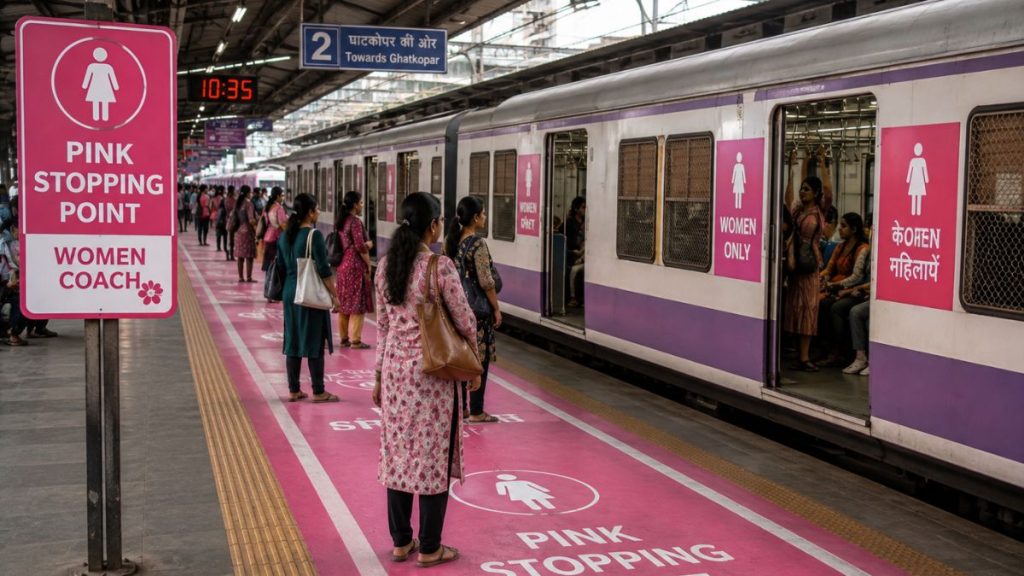
The proposal was discussed during a meeting of the Suburban Railway Users’ Consultative Committee (SRUCC) at the Central Railway headquarters. During the meeting, members also recommended introducing ‘Pink Stopping Points’ on station platforms. These designated areas, marked in pink, would indicate where women coaches halt, enabling passengers to wait at the correct location before the train arrives and reducing crowding, confusion and last-minute rush during boarding.
Railway officials have responded positively to both proposals and have initiated a technical and operational feasibility study. If approved, the measures are expected to be implemented in phases.
According to Central Railway data, the suburban network currently operates 771 women coaches. A 12-coach local train consists of one first-class and two second-class female coaches, while a 15-coach train includes three first-class and two second-class women coaches. As these coaches are presently located at different sections of the train, separate security deployment is required at multiple points.
Lata Argade, President of the Suburban Passengers’ Federation, said that grouping all female coaches together would significantly improve security while reducing manpower requirements. She suggested that the coaches could be placed either behind the motorman’s cabin, adjacent to the guard’s compartment, or at the centre of the train. This arrangement, she said, could reduce the requirement of six security personnel to just two or three while ensuring better protection for women passengers.
SRUCC member Nandkumar Deshmukh said the proposals aim to enhance women’s safety and improve the overall travel experience. He added that the Railways is positively considering both the grouping of women coaches and the introduction of Pink Stopping Points as part of its ongoing efforts to improve passenger safety on Mumbai’s suburban railway network.