Farmers Vow to Resist ‘Third Mumbai’ Project, Refuse to Surrender Land
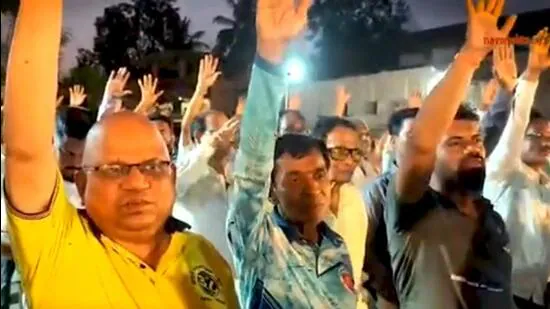
Navi Mumbai,10th June 2026: Hundreds of farmers and residents from 124 villages across Uran, Panvel, and Pen have pledged to oppose the proposed Karnala-Sai-Chirner (KSC) New Town project, popularly known as “Third Mumbai,” declaring that they will not part with even an inch of their land. The resolution was adopted at a convention organized by the MMRDA KSC Navnagar Virodhi Samiti at the historic Chirner Jungle Satyagraha Hutatma Smarak on Tuesday.
The gathering witnessed strong opposition to the ambitious urban development project, with participants raising slogans emphasizing their rights over ancestral land and their determination to protect their villages, livelihoods, and future generations. Organizers said the venue was chosen to symbolize the legacy of the 1930 Chirner Jungle Satyagraha, drawing parallels between the historic struggle and the present movement against land acquisition.
The protest comes shortly after Maharashtra’s Urban Development Department approved the appointment of Singapore-based Surbana Jurong Infrastructure Pte Ltd as the general consultant for preparing the master plan of the proposed KSC New Town. The decision is seen as a significant step towards implementing the project despite growing resistance from local communities.
Managed by the Mumbai Metropolitan Region Development Authority (MMRDA), the proposed ₹4,000-crore project is planned over nearly 323 square kilometres in the Uran, Panvel, and Pen talukas. The state government has projected the project as a major urban expansion initiative aimed at decongesting Mumbai and creating a new economic hub connected to the Atal Setu, Navi Mumbai International Airport, and Jawaharlal Nehru Port Authority (JNPA).
However, local residents fear that the project could result in large-scale displacement and threaten the livelihoods of farmers and fishing communities who have lived in the region for generations.
Addressing the convention, former Bombay High Court judge Justice B.G. Kolse Patil expressed strong support for the farmers’ movement. He stated that any attempt to build Third Mumbai would face fierce opposition from the affected communities and recalled the successful public agitation that halted the proposed Special Economic Zone (SEZ) project in Raigad in 2006.
Sudhakar Patil, President of the MMRDA KSC Navnagar Virodhi Samiti, said the movement is not merely about compensation but about protecting the identity, dignity, and existence of local communities. He alleged that government policies are favoring large investors while failing to provide adequate assurances regarding rehabilitation and long-term security for affected families.
The committee’s General Secretary, Rupesh Patil, claimed that nearly 25,000 objections submitted by residents following the project’s notification in March 2024 were overlooked before the state finalized its land policy. He argued that increasing land values due to infrastructure projects such as the Atal Setu and Navi Mumbai International Airport make it impossible for farmers to reacquire land once it is surrendered.
Social activist Ulka Mahajan also criticized the government’s approach, alleging that decisions affecting thousands of families were being taken without sufficient consultation and public participation.
The opposition has intensified since the Maharashtra government introduced a participatory land acquisition framework through a Government Resolution issued on March 16. The policy offers compensation through cash payments, Transferable Development Rights (TDR), Floor Space Index (FSI), or a 22.5 percent developed land-return model.
Farmer organizations, however, have demanded that the government implement the provisions of the Right to Fair Compensation and Transparency in Land Acquisition, Rehabilitation and Resettlement Act, 2013. They have also raised concerns regarding rehabilitation packages, expansion of village settlements, and the protection of traditional property rights.
Despite the growing resistance, MMRDA has maintained that the project is being implemented according to statutory procedures and is designed to balance urban development with the interests of existing villages and local communities.
With opposition gathering momentum across the affected region, the proposed Third Mumbai project is likely to face a prolonged battle as farmers and residents continue their campaign to protect their land and livelihoods.